
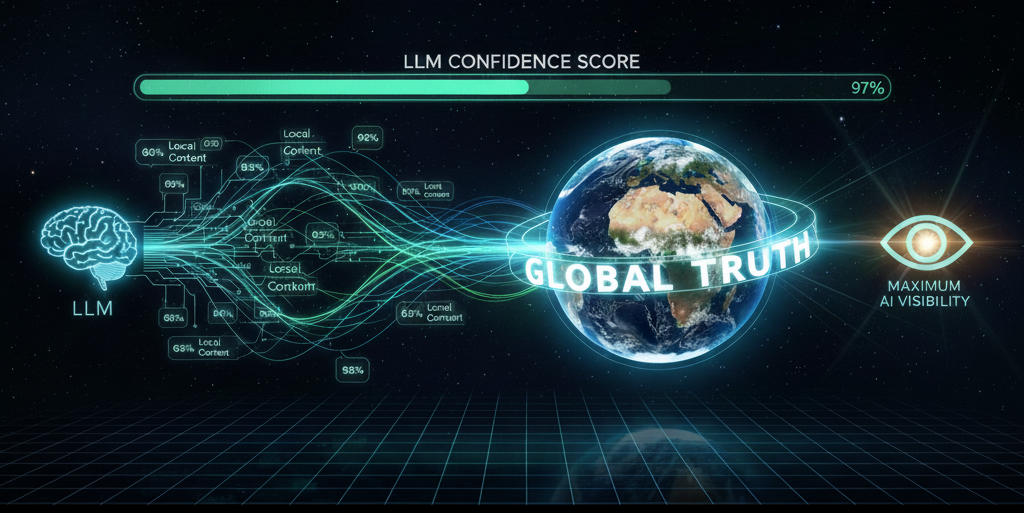
The LLM Confidence Score: How Global Truth Validates Local Content for Maximum AI Visibility
The LLM Confidence Score indicates how confident an AI model is that a brand’s content is accurate, authoritative, and globally consistent. It is earned when localized content precisely validates global source-of-truth claims across markets. A high confidence score increases the probability that LLMs cite, recommend, and prioritize the brand in AI-generated and search-based answers.
For brands operating across multiple markets, this introduces a new mandate: global and local content must be perfectly aligned to earn and sustain AI visibility.
What Is the LLM Confidence Score?
The LLM Confidence Score is an implicit measure used by AI systems to assess:
-
Factual consistency
-
Source authority
-
Cross-market coherence
-
Up-to-date claims
If contradictions exist across languages, regions, or formats - the model’s confidence drops. When confidence drops, visibility drops with it.
The Global Truth: How LLMs Verify Brand Claims
LLMs don’t simply retrieve information - they verify it.
Using large-scale, multilingual retrieval systems, LLMs cross-reference your brand’s claims across:
-
Global English-language “source of truth” content
-
Localized websites and landing pages
-
Regional press releases and PR coverage
-
Technical documentation and regulatory content
This process ensures that what the model generates is not only relevant, but globally defensible.
What LLMs Verify Most Rigorously
-
Foundational brand identity
Mission, positioning, naming, and category definitions must match across all markets. -
Core technical and scientific claims
Product specifications, patents, certifications, financial data, and sustainability claims are validated against a global corpus of authoritative sources.
When consistency is found across regions, the brand is elevated as a high-confidence authority in AI-generated answers.
How LLMs Compare Global and Local Content: RAG Explained
To understand how AI validates content at scale, we need to examine Retrieval-Augmented Generation (RAG) - the core mechanism behind factual AI answers.
1. Retrieval: From Query to Semantic Meaning
When a user asks a question, the system converts it into a vector embedding (a numerical representation of meaning).
That vector is matched against a global knowledge base that includes:
-
Global Anchor Content
Core English-language product documentation, white papers, patents, and global PR. This acts as the primary source of truth. -
Local Content Clusters
Translated pages, regional FAQs, localized specifications, and market-specific regulatory documents.
Importantly, retrieval is based on semantic similarity, not keywords. LLMs retrieve meaning, claims, and implied facts.
2. Augmentation: Cross-Referencing in the Context Window
The most relevant content chunks (typically 5–10 short passages) from both global and local sources are injected into the LLM’s context window.
This is where validation happens.
-
If local content mirrors the global anchor semantically and factually, confidence rises.
-
If even minor discrepancies appear - numbers, dates, terminology - confidence drops.
LLMs treat inconsistencies as factual risk signals.
3. Generation: Confidence Is Earned or Lost
The final answer is generated based on how well the retrieved sources support one another.
-
High LLM Confidence Score
Achieved when local content consistently validates the global claim. -
Low LLM Confidence Score (Hallucination Risk)
Triggered by outdated facts, numerical conflicts, or ambiguous localization. The model may:-
Hedge its answer
-
Omit key claims
-
Favor a competitor with cleaner global consistency
-
The Cost of Global - Local Misalignment
Even small localization errors can materially damage AI visibility.
Real-World Misalignment Scenarios
| Scenario | Global Anchor Claim | Local Content Risk | AI Visibility Impact |
|---|---|---|---|
| Product Specification | Runs on a 24-volt battery system | Local Czech content references “12V” in a translated caption | Numerical conflict lowers confidence; LLM avoids stating specs |
| IP & Patents | Protected by Patent US9876543 | Local press release omits patent reference | Authority diluted; patent not cited in AI answers |
| Sustainability | Net-Zero achieved in 2024 | Local page says “carbon neutral by 2025” | Chronological conflict; AI downgrades achievement |
In all cases, the LLM responds defensively - reducing precision, authority, and brand prominence.
Why Local Content Is No Longer “Just Translation”
Local content is not a linguistic exercise—it is technical validation.
Every localized asset must function as a verifiable proof point of the global source of truth. This means:
-
Exact replication of factual claims
-
Consistent terminology across languages
-
Aligned dates, metrics, and certifications
-
Controlled updates across all markets
For AI systems, local inconsistency equals global uncertainty.
FAQ: LLM Confidence & AI Visibility
What is an LLM Confidence Score?
It is an implicit measure of how confident an AI model is in the accuracy and consistency of information it generates about a brand.
How does local content affect AI visibility?
Local content that contradicts global claims lowers LLM confidence, reducing the likelihood of citations and recommendations.
What is RAG in generative AI?
Retrieval-Augmented Generation combines external authoritative sources with an LLM’s knowledge to generate fact-based answers.
Why is global-local alignment critical for AEO?
Because LLMs cross-reference content across markets. Misalignment introduces factual risk and reduces answer quality.